Saturday, 27 July 2013

54. Rhodes - UNESCO World Heritage City


We came to see Rhodes because it is a UNESCO World Heritage site and we are interested in history.

From Patras, where the international ferry lands all passengers and vehicles travelling from mainland Europe, we needed to make our way to Pireaus, the port of Athens by way of about 150 km of apparently much improved, but still appalling, road.

Signage is either non-existent or only visible to the initiated.  Driving through the outskirts of Athens was an experience in gasping!

The Greek Blue Star ferry from Piraeus to Rhodes was smaller than the Grimaldi Lines international ship, but with excellent facilities.  It was another overnight trip leaving Pireaus at 7pm and arriving in Rhodes at 8am, with with stops at two islands, Hydra and Kos, during the night.  For this trip we scored the dreaded bunk cabin.


At 8am we had no trouble parking right on the quay in front of the gates to the old walled city of Rhodes.


We planned to have a leisurely look around and then come back in a day or two for a good scrounge around the most interesting places.


Inside the city walls you are bombarded by tourist merchandising and eating and drinking establishments with hustlers out front.  They are all operating from updated, but very old premises, probably always used for similar purposes, but it is all a bit "too much".  So we scurried on to see what else might be on offer.


Rhodes certainly looks different.  While it is known as the city of the Knights Templar and has lots of northern European aspects to it, it is also a city responding to its geographic location, hot and dry, and to the other cultures that have always existed here, Turk, Arab, Greek, and more that I don't know enough about to describe.


This is the oldest street in the old town. All of the buildings on this street were built for or by the Knights Templar at the time of the Crusades in the Holy Land.


The notice announces "Restoration of Ramshackle and Hazardous parts of the Grand Master's Palace in the Medieaval city of Rhodes 2007 - 2013".  So we went looking for these ramshackle parts.


Here is the Grand Master's Palace - looking pretty good at the front.  Sadly the rear was still pretty ramshackle and the scaffolding which was erected there looked as if the money had run out back in 2010.


This building in the street of the Knights Templar and Grand Masters Palace had an intriguing emblem, which I imagined probably served as a clue somewhere in the Da Vinci Code.  It was currently the Italian Embassy.


In the same street, a residence with a cool courtyard.


And at the bottom of the street, a church with a Byzantine look about it, undergoing some repair - the single workman on site gave the impression restoration might take some time.


There were some lovely, more recent buildings like this one with a gentle, Moorish feel.


This ruin at the south end of the town was very old and from a time well before the Knights Templar.


You can see the intense blue of the Mediterranean through the door in the old city wall.

For some reason we didn't "connect" with Rhodes.  Maybe it was the heat and dust, maybe it was the tourists, maybe the business hawkers, or maybe we were just too lazy to make it work - but two hours was enough.  It was back to the little yellow car and off to Lindos.


Friday, 26 July 2013

53. The Greek Ferry Business - Brindisi (Italy) to Patras (Greece)

As planned, we arrived in Brindisi on the heel of Italy, at about 2pm.  We drove to the port, not an easy task as the signage was poor and it took two circuits of the entire port area before we twigged to the correct entry gate.  Having traded our online booking confirmation (printed in duplicate, as instructed, on our nifty little €49 printer) into three real tickets (one for us, one for our cabin and one for the car) we left the nearly frying tarmac around the port and scamperred back to the town for a look around.

Capitalising on free parking in the very centre of the old town during siesta, 2pm until 4 pm, we wandered the shady streets and cafes are noted the improvements since our only other visit in 2000.  We tried to make a withdrawel from an ATM inside a bank foyer, but our non European VISA cards were both rejected. At 4pm when the bank reopened after siesta, we watched the circus Italian people have to go through to get to their own money in their own bank.

Firstly, on the street form an orderly single queue - even if you are a couple you may only enter the bank singly.
Secondly, wait your turn.
Thirdly, still waiting your turn in single line enter the bank foyer.
Next, when it is your turn, and only when the light turns green, enter the fully sealed glass cubicle.  The door will close behind you.  You are completely isolated and locked inside this glass box about 90cm X 90 cm.  But don't panic!  Select the correct banking service from the available list (all in Italian) by pressing the appropriate button.  Stay quiet.  Try to relax.  Eventually, all in good time, someone somewhere inside the bank will press a button and release you from the cubicle - all in somebody's good time.
Next - find the correct desk for the service you require and wait for a bank person to turn up to assist you.  You may need to be patient.  No more than two or three people are allowed in the bank at any time so the queues inside aren't long.  But a bit difficult if you are trying to negotiate a joint loan or even a joint account - your partner may still be in the queue outside. 

Apparently it is the same all over Italy. Crazy stuff!  We decided we didn't need to make a withdrawal at all and left with our mouths open.


Back to the ferry.  This is a very big boat!


Waiting in the car queue for the first checkpoint where they take half the car ticket and check that our warning lights both flash on cue.


Driving around the back of this huge boat, as instructed.


Lining up to await our turn.  We waited here for probably 45 minutes while the loading people boarded dozens of trucks - well, not trucks but only the trailers.  There are several prime movers on the dock and they hitch up the trailers and load them onto the ship and then disengage, leaving the trailers there while they go back for another.  Lots and lots of trailers went on first, in the lower sections of the ship, before they would let any cars on.  Next they loaded whole trucks going to the furtherest port - Rhodes and then cars.  All of this took quite a while.


Trying to avoid booking us a cabin with bunks, Paul had erred towards the upper end of the cabin hierarchy and we ended up in one of only two staterooms, right underneath the bridge.  No wonder it was a bit pricey!


A real bed.


A real bathroom.


Once we got over the shock of our luxurious cabin, we sauntered out to the rear deck to see what was happening outside.


There were still dozens of trailers waiting.


And dozens of trucks still to load.


This is a very big ship.  These cars, loading on the top rear deck, have paid a fare which allows them to "camp" in their car overnight.  They have open air and use of the toilet facilities but they must sleep in their vehicle.  For cars in the lower sections of the ship there is no access to the vehicle. You must book a cabin or a seat.


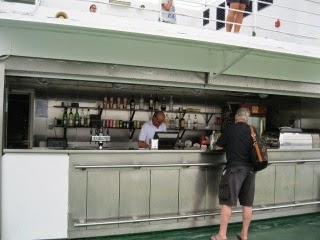
We sat up all night (aircraft type seating) on our first trip to Corfu in 2000.  Never again. Paul buys us a beer at the bar on the rear deck.


The trip from Brindisi, Italy to Patras, Greece takes 17 hours, so it's a cabin and a bed for us!


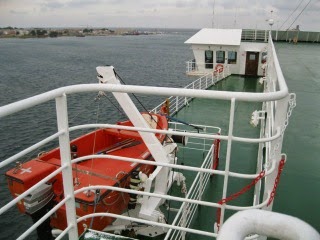
Lifeboats.  It's always wise to check the lifeboats on a Greek ferry.


This snappy little number is rigged just behind the bridge - assuming it is for the captain.  That protruding square hut is the bridge. Our cabin is just below it.  So maybe we could claim this lifeboat, too.


There is a helicopter pad but it has been taken over by hippies, playing musical instruments and chanting.


Sixteen hours later, as we approach Patras, most of the "camping" cars have disappeared, They must have disembarked in Igoloumesto at about 6am.  The remainder are going to Patras with us.


Because we were among the eary boardeers we are amongst the last to leave.  No-one can access their car yet as they have to wait for this level to clear .... before the crew will 


.... raise the steel floor ....


.... to allow access to the lowest level.  See all of the trailers crammed in down there.


Talk about jam-packed!  On the right hand side of the column are about 50 motorcycles.


On the left hand side of the same column, and stacked at about 60 degrees on the entry-exit ramp are about 6 vehicles.


While at the very lowest level are hundreds of cars, all of which have to either back up that 60 degree ramp, or manage to turn around and drive out.  Some drivers could manage neither the reversing nor the hand break starts on the ramp nor the turn-arounds and had to be replaced by crew.  Makes you wonder how some people get a license.  But  so what? - it is all entertainment.

You just don't want to be claustrophobic.

Welcome to Greece.

52. A Typical Italian Beach on the Adriatic - Termoli


We are travelling down the east coast of Italy, along the Adriatic, to Brindisi to catch a ferry to Greece.


This is the small city of Termoli, our last stop in Italy before Greece.  Tomorrow we will arrive in Brindisi about 4pm and drive straight on to the ferry that leaves at 7pm.  


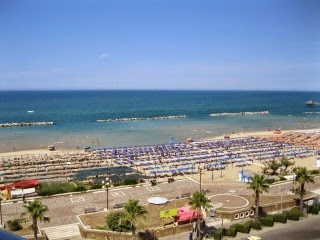
Termoli is typical of all of the towns along the east coast - high rise holiday apartments and acres of flat beach.


When you book your holiday accommodation you also book and hire your umbrella and sun lounge.


There are acres and acres of umbrellas, different colours depicting different owners, all lowered each night and raised again the next day.


Despite the umbrellas there are actually not many tourists here and it is the first week of July (the second month of summer).  It's a worry!  Not for us, but for the tourist operators.


51. The Republic of San Marino

Second on Paul's birthday list after the Museo Ferrari and way back on 2 July, was a visit to the tiny country of San Marino which is located in north east Italy.

The Republic of San Marino is literally a mountain, with an ancient castle on the very peak.  The hotel that Paul chose was only marginally lower than the castle and the road up the mountain stopped at the hotel's front door.  We copped heaps from the old lady at the hotel for driving the final 100 metres of the road, through the old village centre to reach the hotel.

Didn't we read the hotel instructions printed on our booking confirmation telling us that the final section of road was pedestrians only during the day? Didn't we see the signs at the old medieval gate advising no cars in the old town until 7 o'clock? Were we stupido? What did we think we were doing? Who did we think we were?  She gave us a real blast!


Well! Paul was both offended and mortified.  Given his attention to every detail of whatever he does, he was sure he had read and understood the arrival instructions correctly.  He apologised to the old lady for his error and retreated to his computer (and her internet) to re-check the detail, but not before he threw open our window to take in the view.


When next he ventured into reception, the old lady was on the terrace enjoying her bird's eye view of the village's evening activity and a younger man, about our age and possibly her son, was behind the desk. 
  
Never to be out-gunned, especially by a crotchety old woman, Paul pointed out to the aforesaid gent that the hotel's English translation of the pedestrian zone times printed on our booking slip, actually said "No entry between 7pm and 10am", whereas, to be correct, it should read "No entry between 10am and 7pm".  It really does make a big difference, explained Paul.  Completely baffled and unable to understand the finer point of the differences between the two instructions, the gent says "Well, no worries signore, the cameras weren't turned on today anyway."

But we did notice we got better than the previous service from the old lady when we sat on her terrace, petted her dog, ordered a beer and marvelled at her view.


San Marino is a wealthy enclave that tries to remain aloof from the mess of Italy that surrounds it. It is an independent Republic about 30 km long by 5 km wide and is, quite literally, a mountain! 


As soon as the road from Rimini (on the coast) crosses the border into the Republic it begins to climb and doesn't stop until it gets to our hotel and the castle at the very top. So of course, the views are stunning.


When we climbed up to the castle around 5pm, the local historical society members were rehearsing for a performance.


Looking east, the shadow of the mountain and its the castle make an interesting picture.


In the distance is the Italian coast, the Adriatic, about 20 km away.


Looking out the other way, along the ramparts that were the original mediaeval town walls.


From the castle looking along the mountain edge to the Eagle's Eyrie restaurant at the very tip where we enjoyed a great birthday dinner.


Waiting for the pizza to arrive between rehearsal and the main performance at 9.30pm.


That's Paul up there at the very top window.  It was necessary to climb through a vertical stone tunnel to get there.  There was no way I could face that after years of "trapped in a dark tunnel" nightmares from years ago.


The dungeons and soldiers barracks.


A very old medallion of San Marino showing the castle and fortified city on the rock mountain.  The site is UNESCO World Heritage listed.


The notice on the wall as we left the castle reads:


The First Tower of Guaita
The Children and the Court of Olneibo
and
The Dramatic Company of Istriche
present
the spectacle of the historical reconstruction
The Time of the WitchHunt
- the trial of the witch.
This evening at 21.30
Free entry

There was a lot of blood flying around at rehearsal so I suspect the end won't be pretty - the costumes were good, though.