Sunday, 11 August 2013

61. Kalymnos - Our last Greek Island

The last island on our tour of the Dodecanese in the South Aegean was Kalymnos.  

Kalymnos is pronounced Kalim-nos with the emphasis on the -nos. Many, many Kalymnians emigrated to Australia after WWII and there is a regular stream of visitors of Kalymnian heritage from Australia.  


Of all the Dodecanese islands that we visited, Kalymnos was the most disappointing and the most concerning.  It reflected many of the practices of the northern mainland cities and few of the forward-looking ideas of the other islands.


And while there were some untouched areas of great, rugged beauty, much of the island was run-down and less than cared for.


We stayed for a week in Myrties on the north-west of the island, right on the water and directly opposite the small island of Telendos.  The advertising for this hotel said that if you fell off the verandah you'd be in the water - and it was true.


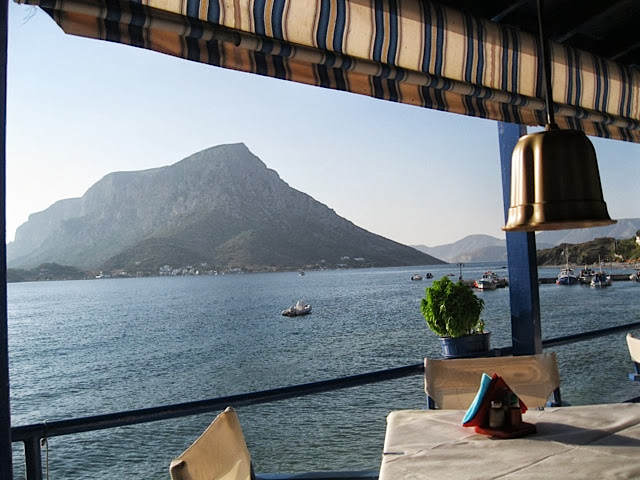
And that is Telendos, just a boat ride away.  The boats in question are lined up at the little wharf on the right of the picture.  Two euros per person each way and a boats leaves every thirty minutes.


This was the view from our tiny balcony.  Unfortunately, one had to stand up to see the view, if you sat down you were looking at a wall.  The hotel next to ours was an example of how run down many of the hotels and restaurants are.


Looking back at Myrties and our white, waterfront hotel (centre) from the boat.


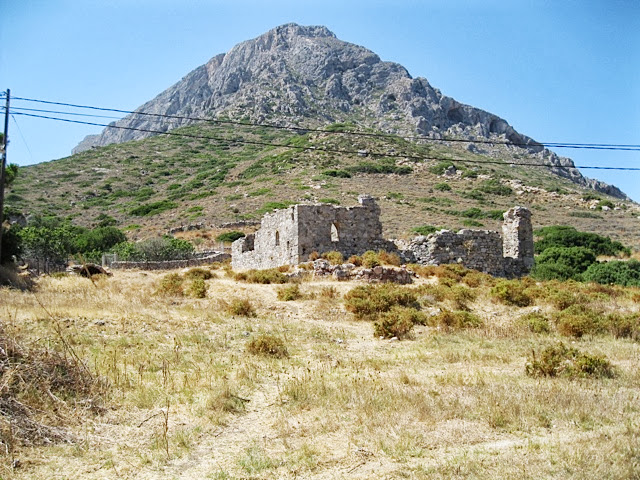
This is the signage used throughout the Dodecanese island group to display their heritage.  No mater how significant the site might be, there is only one sign, just like this - nothing else, not even for a church or monastery.


So I can't tell you anything about this early Christian basilica.


We had swims and sun and found cool drinks in one of the many tavernas that line the shore and operate from Spring to Autumn.  The residents of of Telendos move to the bigger island for the winter.


It was very pleasant on the little island - Myrties and our hotel faced west and baked in the afternnon sun, wheras Telendos was partly shaded during the hottest part of the day.  Looking back at Kalymnos you can see that it is extremely mountainous and rocky and that the villages hug the lower and greener parts of the costal strip.


This lucky lad got to drive the boat home!


We only visited the islands main city of Kalymnos and the port once.  This is the new marina.


A very strange design.


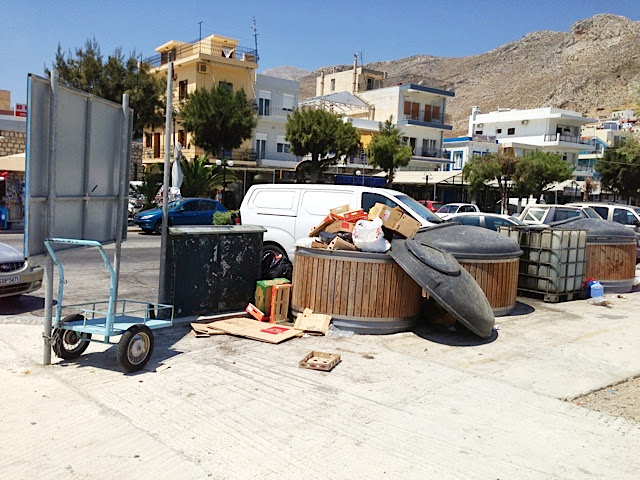
Rubbish bins at the new marina.


And on it goes.  I could show you so much more but it is too demoralising.


In the background are the daily tour boats that leave the old marina area every day to tour the bays and beaches around the island.  They look like pirate boats - at least that's what I've been telling Jack and Henry.


These are the bays and coves that are often full of boats.  Turkey is in the background.


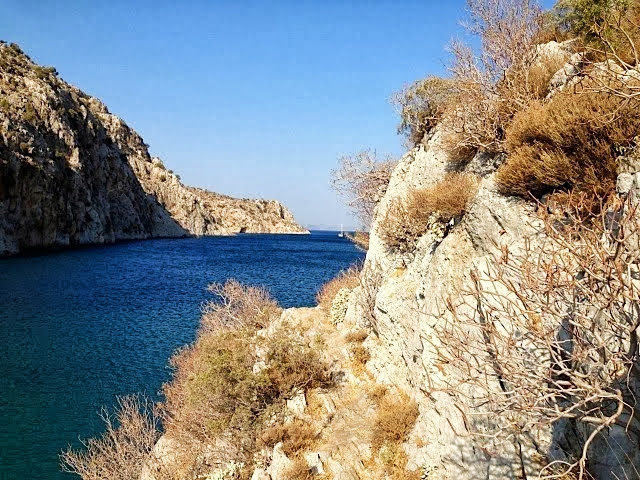
Down in the valley is a processing plant for the fish farms sprinkled around various bays.  You can see 4 or 5 circular 'ponds' in the water.  The country is rugged and quite beautiful.  Not a tree in sight but the stone is punctuated by a lot of small herbs, mostly thyme but also oregano and rosemary.  And there are beehives (boxes) everywhere to collect the honey.


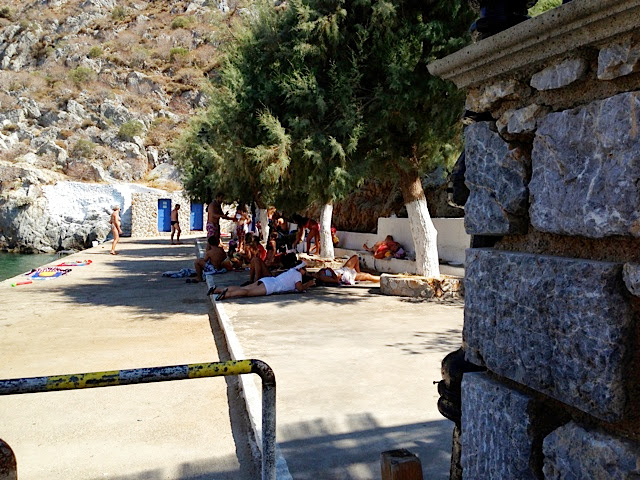
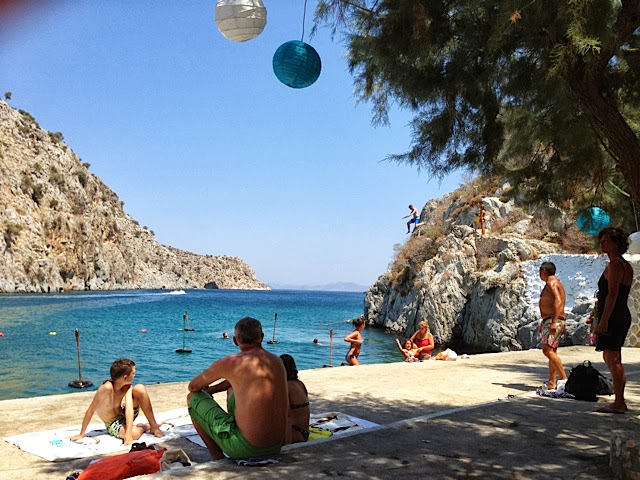
We finally found a gorgeous little village with a tiny port, out of the wind in the southern part of the island, and this became our preferred spot for the last three days of our week on Kalymnos.  No beach but this shady and pleasant concreted area at the side of the port and next to a restaurant/taverna.


The yatchties obviously know about this village, called Vathi because most berths were taken.


The swimming was fabulous as the water was extremely deep, and the locals and visitors alike, scrambled up the cliffs on the right to jump into the water.  Some of the local 10 year olds were quite accomplished divers.


And then all of a sudden we were invaded by pirates!  Two boats arrived at once.  The concrete beach was full of sunbathers.  The water was full of swimmers and divers.


Noise and action everywhere. Ninety minutes later a horn toots, and then another.  before we know it, one boat has left, then the other ...........


... and peace reigns again!  The local kids go back to jumping off the rock and we all heaved a sigh of relief.  On subsequent visits we delayed our arrival until after the pirates had departed.


Because the tour boat operators supply food and drinks on board, the visitors spend very little money in the port's shops or tavernas, but the village needs to supply toilets, water, garbage collection, etc.  One would hope there is some compensation for the village from the tour operators somwhere along the line.


This smaller 'pirate' boat looks very authentic against the rocky cliffs.

Our overnight ferry crossing from Kalymnos to Pireaus was uneventful but we got a bit lost in Athens and it took an extra 10kms to get out of the main city and on to the road to Patras.  The Greeks are worse drivers than the Italians.  The suburbs of Athens are crumbling under the sheer weight of humanity and its waste.

From the new ferry port at Patras (200 km from Athens) another overnight ferry took us to Bari on the east coast of Italy, from which we puttered our way to Naples - Ercole to be exact - right at the foot of Mt Vesuvius.

Next - the ancient ruins of Herculaneum.

Friday, 2 August 2013

60. Patmos and the Monastery of St. John

Welcome to Patmos, another in the Dodecanese island group in the South Aegean.  The word dodecanese means "twelve" but there are actually 26 islands in the group as well as lots of small rocky atolls.


Tourists have come to Patmos since ancient times as pilgrims to the site where St. John is said to have written his gospel.  This is the ancient monastry of St. John surrounded by the Chora of Patmos.


Visitors still flock here as Patmos and St.John are on the 3 day and 6 day Mediterraen Tour itineries of two companies from Pireaus, the port of Athens.


Arriving 4,000 at a time in these enormous cruise ships, passengers are brought ashore by tenders that run flat out for several hours ferrying them all from the ship to the port, and later, taking several hours to return them again.


The port is narrow, so the huge ships must anchor quite a long way out.  The tenders therefore have a long run, back and forth.


Once ashore, the 4,000 need to be got to the monastery as fast as possible by a fleet of buses and taxis.  The ancient monastery and its resources are then faced with hosting the 4,000 tourists over the space of about 3 hours - a mammoth task.  

I was quite overwhelmed by the whole concept of this onslaught happening not just here in Patmos four times a week, but at every other site in the Mediterranean where these monstorous ships stop.  It makes you stop and think about the real impact that modern tourism is having and how fragile our environment is.  Just think of the requirements to provide toilet facilities, water and petrol not to mention the rest.

Previously Patmos had 9 of these episodes a week.  Now there are only four.  The other 5 visits are taking place elsewhere in the Greek islands.

I couldn't go to the monestry after this.


We went swimming instead.


The water is so clear and gets deep quite quickly.


This spot was lovely but it was a road and car park, as well as a beach.  Good for an hour to swim and read but too dusty to stay longer, especially once the breeze came up.


Most of the islands have restored their old windmills.


There were lots of interesting little ports like this one, busy with pleasure craft of all sorts.


All shapes and sizes, some beautifully painted.


Even if there was no beach, you could always find somewhere to get into the water.


Or like me, find a nice tree to lay under.


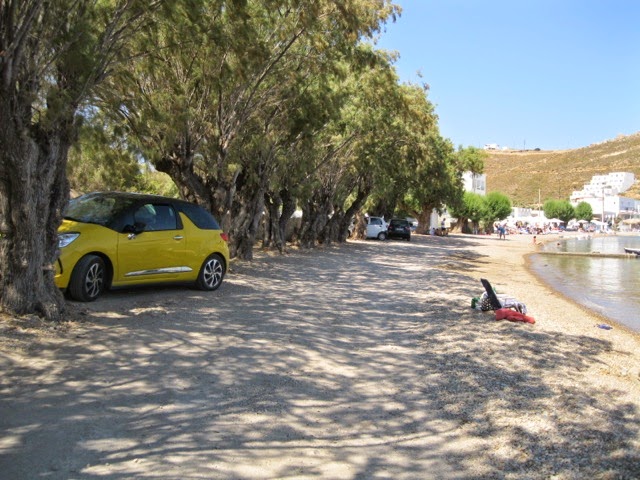
The racey yellow car, parked opposite our hotel, with the Dodekanisos Pride catamaran that will take us to Kalymnos tomorrow.


And this had to be the most ungainly boat on Patmos - Paul christened it "The Pope-moboat".

See you next on Kalymnos.


59. Lipsi 2 - Some excellent photographs


Yesterday I received some photos from Giovanni and Ivan, whom we met on the little island of Lipsi, a couple of weeks ago.  


The photographs are so good I couldn't resist sharing them.


Giovanni and Ivan are great walkers, unlike yours truly, and they combed all the roads and hillsides of Lipsi that we only skimmed in our little yellow car.   No wonder they were able to get photos like this!


And like this!


We buzzed along the roads too quickly to catch detail.  I guess when you stop at the top of a hill to catch your breath, you also catch the view.


The water in the islands is incredibly clear, and of course the rock is under the sea as well as everywhere else in the landscape.


And the water gets deep very quickly as the hills tumble down into the water.


You can see how close the dark, deep water is to the shore.


The pink glow of sunset behind the harbour.


Ivan and Giovanni stop for a word with Yannis, the sponge seller, in the late afternoon on their way home from the beach.


Another Yannis (pronounced "Yarni"), this time Yannis the restauranteur, delivering our dinner.  Ivan and Paul both had pastisios, which is likes a baked tomato pasta, while Giovanni and I had moussaka, layered eggplant and potato covered by béchamel and baked.  Moussaka is pronounced "moo - sa - ka" with the emphasis on the "ka".  


Thank you both so much for sharing your photographs and your company.