Saturday, 17 August 2013

65. Spoleto - Umbria


Some places are very difficult to photograph.  Spoleto is one of those.  It sits gently in its landscape and even though it is high up and quite steep internally, it is not like a typical medieval hill-town.  It is a bit like a layer of thick chocolate icing on top of a cupcake, with a square cherry on the top.


I think this photograph which Paul took from the highway as we left, is as good as we were able to get. The bulk of the city is to the left and the fortress sits on the highest part of the hill with the road running through the river valley below.


The fortress is officially called the Rocca Albornoziana di Spoleto.  It was commissioned to be built around 1360 to form a papal stronghold and win back papal territories in the region.  This was the era when the papacy had lost control of power in Rome and had retreated to Avignon in France - hence the Palace of the Popes in Avignon and lots of associated development in that area such as Chateauneuf du Pape, the wine area on the Rhone.  

But back to the Rocca - the pope who commissioned the Rocca was from a Spoleto family so it was in his interest to have a strong fortress in his seat of power.  The original building was half the size of the one you see today.  Extensions and renovations took place continually.


The fortress was serviced by an aqueduct carrying water from springs in the mountain across the valley of the river Clitunno.


This time the aqueduct is medieval rather than Roman.  The spring water was sourced and managed at the tower across the valley and was channeled into the lower part of the fortress, where it was mechanically pumped/lifted up through the building to the well in the courtyard.


This is the courtyard with a decorative structure around the well, added much later than the original, handsome colonnaded upper and lower galleries.


There are magnificent views of the city from the upper gallery.  The building's role as a fortress waned and it became the seat of the Dukes of Spoleto and the Governor of the Duchy.  But eventually the Governor moved into the town and from 1817 until 1982, the fortress was a high security prison before its transfer to the Department of Heritage and its rebirth as the National Museum of the Duchy of Spoleto.


We first arrived in Spoleto in the late afternoon and our first walk from the hotel into the central area of the city took us through this graceful park just as the lights came on at dusk.


Mosts weeks of the year the city hosts cultural events for the community.  On this particular evening it was a dinner in the park, catered by one of the city's restaurants and open to anyone who was willing to to pre-book (and pay, of course). The following day it was a two act play (unfortunately for me, in Italian) for an entrance price of 5€.


Our first day of discovering the city turned up this excavated Roman theatre which I hope to make the focus of another blog.  It and its Archeological Museum were very interesting.  The seating and the semi-circular orchestra area are well preserved. But the stage and back-stage area were damaged when the church (tall, large grey mass on right) was originally built in the 13th C.  Lots more in next post.


Spoletto is spotlessly clean and in good repair, especially in the main inner city areas.


Doors, mailboxes, steps, planters ......


The inner city road leads uphill with cafes in the shade at the sides.


This is the large piazza in front of the cathedral and, at festival time, it hosts many recitals and performances, crammed with people on seats and sitting on the wide steps leading forever upwards.  This is the main tourist drag but it remains almost pristine.  There is absolutely no advertising anywhere in the historical city - except for traditional posters advertising cultural events and the Festival.


If Juliet hadn't had her tiny curved balcony, she could have pined for Romeo from this handsome crossover number.


There is sculpture everywhere.  Although I didn't read about it, I suspect they have a bi- or tri- annual sculpture competition and the city gets to display the winners - like this one.


The town hall and council headquarters and civic piazza.


The municipal vehicle fleet? Or is it the mayor's car? A Smart 2x2.


Obviously, the mayor can't drive everywhere.


Paul playing 'tease the gorilla' in front of an art gallery called - The Palazzo Collicola Arti Visive and the Appartamento Nobile.  


The Appartamento Nobile was a restored gentleman's residence or palazzo of the 16thC.  It was beautiful with marble doorways, exquisite parquetry and stone floors and a world famous collection of wall tables.


A wide variety of old and new pieces were displayed together.


This glorious glassed in verandah faced west - OK in Winter but I don't know how they have retained the decoration all these years given the 40°+ on the Summer day we visited.


A section of painted, wooden ceiling.


This bronze and plastic work was exhibited on the floor and entitled 'Hermes Resting'.


A novel display of contemporary drawings.


An inlaid wooden cabinet.  It's not paint - it's all wood.

And here is my absolute favourite ........


Three walls of a stairwell.  It had something to do with patronage for street art.  This painter was Spanish.


Brilliant - but a bit scary!


64. A little bit of art and culture in Spoleto


From the 2,000 year old ruins of Herculaneum to the other end of the time spectrum - we found ourselves at the Hotel Albornoz - a palace of contemporary arts.  


We spent four restful and enjoyable days in Spoleto at this lovely four-star hotel.  We have found that the big, fully serviced Italian hotels (pool, restaurant, good wifi and breakfast) like this one, have been less expensive than B&Bs and quirky Italian family apartments.


Spoleto is a beautiful small city and it has hosted its annual Spoleto Festival for around 55 years.  


The city has made every effort possible to ensure their festival is a success - public transport links from all over Italy and abroad, great arrangements for visitor car parking outside the city centre with kilometres of underground escalators to move visitors around the hilly city, from car parks to venues and from venue to venue.  
The festival takes place in every aspect of the city - in the palazzos, in the piazzas, in the restaurants, in the art galleries, in the historical monuments, in the parks and in the hotels.  Nothing is sacred.  Every asset and aspect of the city hosts events.  

Spoletto is probably about the size of Warrnabool, perhaps a bit smaller.


But back to our hotel.  This hotel does not just hang paintings on the walls.  It has commissioned artists to make their art an intrinsic part of each public area of the hotel.  

Such as this circular brass sculpture that is actually the cover of the fire hose.


This magnificent work of four enamelled copper panels is the door to the dining room.


You pass this lineal work in pastel on the way to reception.


At reception you have these lovely objects to look at (and touch!) as you wait.


Paintings, photographs, sculpture on the way to a little computer room.


Constructed from melted down CDs, this great work is on the wall of the breakfast room where everyone seemed to want to check their email at breakfast.


But this was the one that made you gasp.  They had removed the walls on two sides of the lift and replaced them with glass.  


And for six levels, these male and female acrobats cavort up and down the inside of the lift shaft.


Every room has works of art.  We had this large three dimensional construction plus a gorgeous set of three white, conical table lamps.  You can see one of the small bedside lamps here.


Everywhere you looked there was sculpture.  This circular, semi-inset creation lived on  the grass adjacent to the outside dining area and was a great favourite with the kids.


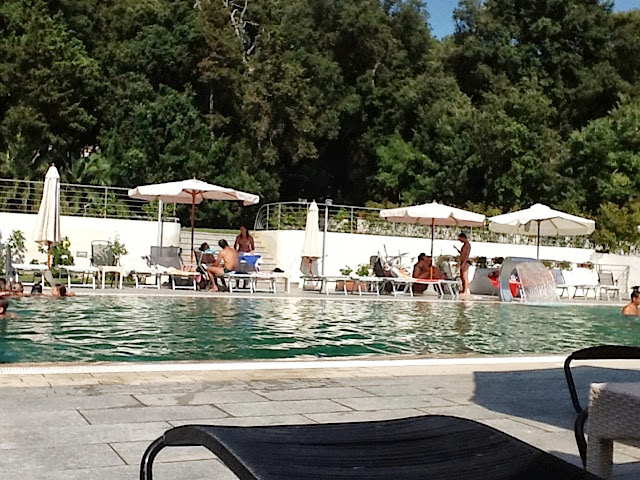
Even the pool area had installations.  I particularly like this great big red thing; it reminded me of the pool being wrapped up like a gift with a red bow.

The hotel was a monumental credit to its two owners and their fabulous (and expensive) investment in the visual arts and in their city of Spoleto.


Friday, 16 August 2013

63. The Buried City of Herculaneum

This is our second visit to Herculaneum because we both find Roman history fascinating.  We visited Pompeii in 1998 and Herculaneum in 2000.  So, after a decent break, we are back to see if anything has changed.

Pompeii is a much larger archeological site and more monumental than Herculaneum. It includes a forum and numerous civic and religious buildings that have not been found within the archaeological boundaries here.  However, the dynamics of the burial of Herculaneum in 79AD are different to Pompeii.

Here the city was covered by flows of pyroclastic rock (pumice and ash) to about 20 metres preserving organic materials such as plants, fabrics, furniture, structural wood and even a boat. In addition, it conserved the upper floors of buildings and with them, knowledge of volumes and building techniques.

It seems that the people in Herculaneum died from heat exposure rather than from drowning in molten lava as in Pompeii and the city was covered by extremely hot but light rock, rather than heavier lava.


Excavations began in 1738 using the technique of tunnels and ventilation shafts, and continued until 1828 when open air digs were carried out until 1875.  During this 137 year period most of Herculaneum's treasures were plundered and removed to the homes of the wealthy and powerful.  In 1927, work resumed and continued until 1958.  Work undertaken during the past 20 years has concentrated on exploring the ancient shoreline and protecting the already unearthed city from damage by pollution, sun, wind and rain and tourists.  One gets the strong impression that the site runs on a shoestring of funds that trickle in from America and little is contributed by the Italian authorities.


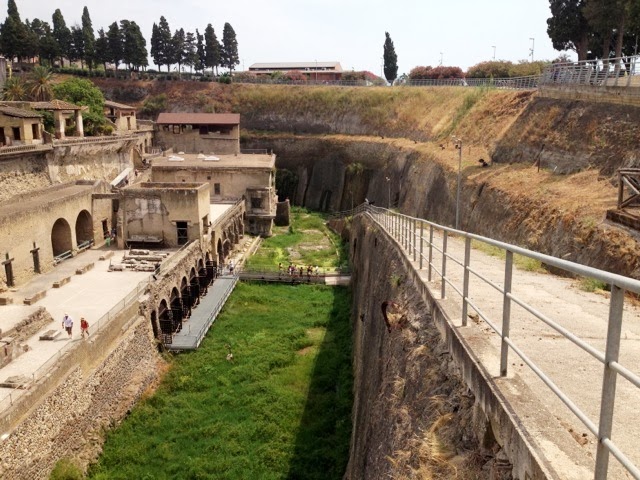
The photo above shows the vaulted rooms, port warehouses and boat sheds that opened onto the ancient beach and which support the imposing structures of the suburban baths on the right and the piazza above. 
In these vaulted rooms, 300 skeletons have been found; people trying to flee the eruption by heading to the sea but who were killed by the heat of the blazing clouds of rock and ash exploding from the volcano.  In the same area, archeologists have found a well preserved 9 metre wooden Roman boat with the skeleton known as "the rower", together with a soldier with belt, two swords, daggers and a bag of coins.   Unfortunately none of these discoveries are on display and neither are the vaulted rooms, the suburban baths, the House of Papyri or several other houses we saw in 2000.  The official explanation for their closure is 'a lack of resources'.  


In the piazza above the ancient beach is this marble funeral alter.  In Roman cities, bodies could not be buried within the city walls so cremation was preferred.  This cremation alter was dedicated to the Senator who was later to become the Roman Emperor Augustus and who was a great supporter of urban and cultural development, including here in Herculaneum.  That is his statue behind the alter.


The house above belonged to a wealthy person - we know this because it is large, it has a garden and it has a view of the sea. About the same as any location in the world, really.  
Although this house has not yet been restored, you can clearly see the impluvium, a feature of every Roman house.  The impluvium is a shallow basin, in the centre of the atrium of the house, into which rainwater flows down from the compluvium in the roof. The compluvium is a square opening in the centre of the roof over the atrium which conveys rainwater down to the impluvium.


The Large Taberna - this is a pub with a marble covered counter in which dolia (jars) are inserted.  Fires underneath the counter kept food hot.  On the staggered shelves, also coloured with marble, were stored the containers for serving food and drink.  The taberna was connected to two atrium-style dwellings, probably traveller accommodation.


This cavern and its associated tunnels was part of the aqueduct and the sewerage system, but we couldn't quite determine how it all worked.  However we do know that every dwelling and shop in Herculaneum had its own sewered toilet and most had their own water supply.  Unfortunately, the water system utilised lead pipes and the skeletons that were uncovered in the excavation showed the population was slowly dying from lead poisoning.


Rather than blackening or charring the decorative layers that were applied to most surfaces, the intense heat from the eruption baked the colours to a higher intensity than originally.  Even in frescoes like those on this column, open to the elements now for more than 100 years, the colours are still quite intense.


The roads in Herculaneum are narrow and designed for foot traffic only - no carts allowed, only porters.  In Pompeii, the roads are wider and are deeply rutted from the heavy wooden carts used to carry goods around the city.


An original water trough.


Although we didn't see anyone who looked like an archeologist (whatever an archeologist looks like) or even anyone who looked as if they might possibly be working, one gets the feeling that a lot of a action could happen here.


Many, but not all roads have these columns on the edge of the footpath which would have supported verandahs and second-storey structures above.  These columns have lost most of their decorative layers, exposing the terracotta brick from which they are made.


And there are ramps on the footpaths for the oldies because the gutters are very deep. You'll also notice the oldies are carrying an umbrella - for shade!


The colour of this fresco in a private house is very intense, again as a result of the heat.


Mosaic floor detail that is still all complete.


And look at the frescos in this dining room - they have been superbly conserved.  This wall painting is 2,000 years old!


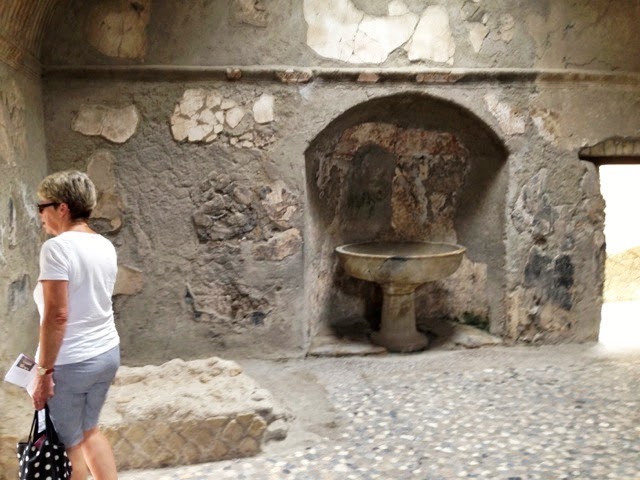
It was 38 degrees on the day of our visit and oppresively humid.  I'm in the dressing room of the men's baths looking for my water bottle.  The shelves above my head are where a man would have put his clothes while he bathed, exfoliated and did a bit of business.  Men favoured bathing between 9am and 3pm whereas women bathed in the late afternoon.


Business was done in this area after sport, exercise and bathing.  Not sure about the big dish at the back but it had some heating function.


Another view of the men's changing room.


This is a fabulous mosaic of Neptune on the floor of the room with the hot bath.


This house belonged to a merchant who conducted his business from home, hence the sliding wooden screens across the front of his office.  Although the screens have now been enclosed in perspex to save them from further deterioration, what you see here are the 2,000 year old originals.  You can also see the impluvium which would have been full of water, keeping the inside of the house cool.


This was a shop that sold amphoras.  Even the wooden stacking racks were preserved.


This area is part of a luxury hotel that overlooked the sea.  It had an internal garden.


To get it all in perspective:

  • the green area at the bottom of the photo is the original beach
  • their are about 6 people standing on the walk way
  • the arched warehouses and boat sheds form part of the supporting structure for the first level of the city
  • above the piazza and buildings of the first level, we can see the second level, the houses and hotels with sea views
  • on the right hand side are the two seperate excavation levels, plus the ramp, that were required to uncover the city.

Truly amazing!  

I wonder why it doesn't meet the requirements for UNESCO World Heritage status?


Monday, 12 August 2013

62. A Visit to Naples


We have swapped the depressing mess of Greece (with exceptions) for the equally depressing 
mess of Naples (also with exceptions) and found ourselves at a lovely hotel in an old 19th Century
mansion in the heart of Ercole, at the foot of Mt. Vesuvius, and 200 metres from the archeological
site of Herculaneum.


So, blessed with these lovely surroundings ...


... we strung up a washing line in the bathroom and over the next three days, hand scrubbed our shorts and t-shirts ready for the next phase of our holiday - Italy.


It was 38 degrees for each of the three days we were in Naples, not great weather for scrambling over Roman roads and through 2,000 year old buildings, but we had a lovely pool to come back to and the food had improved greatly.


The hotel was huge, an old mansion from the days of opulence, and is the venue for many weddings.


There were fabulous flower arrangements everywhere.  All artificial, but very well done.  So, having pampered ourselves here for a day .......


... it was time to rediscover the ancient Roman city of Herculaneum, buried by the volcano Vesuvius in 79AD, here on the Bay of Naples.


The main gate is two hundred metres down this road on the left - just before the cream building with the red roof.


This was our first view of the excavated city as we walked down the entry ramp.  You can see modern day Naples at the rear on the highest level.

On the lower level, where the people are standing on the boardwalk, is a row of arched boathouses.  This was the beach of ancient Herculaneum.  The volcano covered this area with 20 metres of fiery hot rock and ash and moved the coastline forward about 100 metres.

In this photo, taken from our hotel window, we estimate the the Herculaneum beach was about on
the far side of the dingy green two storey building at the rear left of the disused trellised garden.  
And you can see where the beachfront is today.

So all of the area we are looking at is volcanic rock and ash.  And as only 4 hectares of the 20 
hectares of Herculaneum has been excavated, it is quite possible that more remains of the ancient
city are underneath some of this 'view'.

Herculaneum Part 2 follows.